
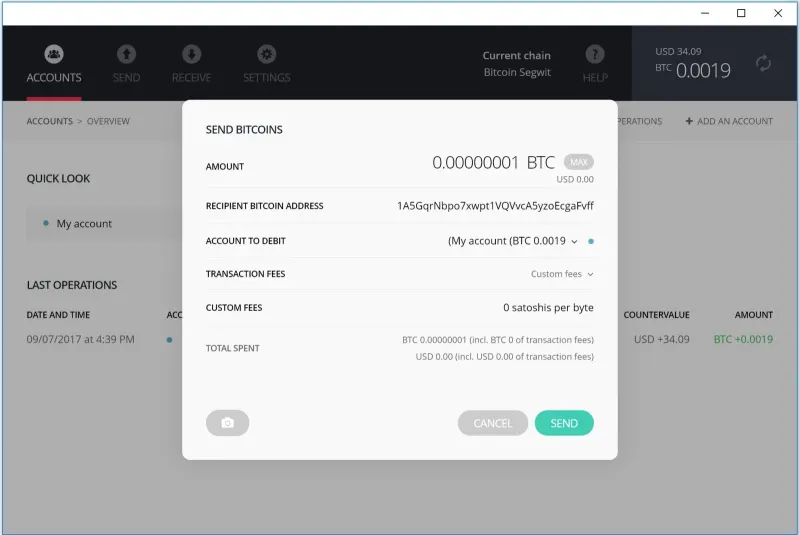
What “unconfirmed” means on Bitcoin
After a wallet broadcasts a Bitcoin transaction, nodes may relay it and hold it in their memory pools, often called mempools, until miners include it in a block. A transaction with zero confirmations has not yet been included in a confirmed block. It may be visible to many nodes, visible to only some nodes, or absent from a particular explorer’s current view. The coins are not necessarily lost simply because a wallet labels a transaction “pending.”
Bitcoin blocks have limited space, and miners generally prefer transactions that pay a higher fee relative to their virtual size. That fee rate is often quoted in satoshis per virtual byte (sat/vB). When demand for block space rises, a fee rate that was adequate when the transaction was created may become less competitive. When demand falls, a low-fee transaction may be confirmed without any intervention. No wallet or explorer can promise an exact confirmation time because block production and transaction selection are variable.
Check the transaction before taking action
Open the transaction in the wallet that sent it and copy its TxID. Search it on a reputable Bitcoin explorer such as mempool.space or another established explorer. Confirm the amount, recipient, time, fee rate and status. Check whether the transaction signals Replace-by-Fee (RBF), if the explorer or wallet exposes that information. If the hash is not found, confirm that you selected Bitcoin mainnet rather than a test network and ask the sending wallet whether it broadcast the transaction.
Compare the transaction’s fee rate with current estimates, but treat estimates as a snapshot, not a guarantee. A fee calculator predicts a likely range from recent conditions; it cannot know exactly what future blocks will include. If the transaction is urgent, your wallet supports fee bumping and you understand the cost, a replacement may help. If it is not urgent, waiting may be safer and cheaper. Avoid using a second payment as a “test” while the first is unresolved.
Option 1: Wait and monitor
Waiting is reasonable when the payment is not time-sensitive, the transaction is correctly constructed and you do not want to pay another fee. Mempool demand changes over time. Some transactions confirm when higher-fee traffic clears. Wallets may rebroadcast transactions that remain unconfirmed, so the transaction could still confirm later. Keep the TxID and check it periodically rather than refreshing an explorer every few seconds.
If a transaction is dropped from one node’s mempool, that does not by itself mean every node has forgotten it or that the payment is canceled. Different nodes have different policies and eviction timers, and a wallet may broadcast it again. A transaction that remains unconfirmed can later be confirmed if it is rebroadcast and still valid. Do not assume the funds are spendable again until you confirm what your wallet and the network show.
Option 2: Replace-by-Fee (RBF)
Replace-by-Fee allows the sender to create a replacement version of an unconfirmed transaction that pays a higher fee. The replacement spends the same inputs and generally keeps the intended payment, but the wallet may change the exact transaction structure. If a receiver is waiting for the payment, let them know that it is unconfirmed and could be replaced; zero-confirmation payments carry risk because the transaction is not yet secured by a block.
RBF must be supported by the wallet and permitted by the transaction and node policies involved. The sending wallet usually offers a “bump fee” or “speed up” option when the transaction is eligible. Review the replacement’s recipient and amount before confirming. You will pay an additional or higher network fee. If the replacement confirms, the original transaction is superseded for the same inputs and should not also be treated as a second payment, but payment systems and wallets may display the history differently.
An RBF flag is not an instruction that the transaction will definitely be replaced, nor does it mean the transaction is unsafe by itself. It is a signal that a compatible sender can propose a replacement under relay policy. The replacement generally needs to pay enough to satisfy incremental fee and rate rules, and nodes or miners may have different views of the competing versions. Wallet interfaces usually handle these details; manually constructing a replacement requires a clear understanding of inputs, change and recipients. Never sign a replacement transaction whose outputs you have not verified on the hardware wallet or trusted screen.
If a merchant or exchange shows a deposit as pending, ask how it handles replacement transactions before trying to speed up the payment. A replacement should preserve the intended payment output, but a mistaken replacement can change the amount or destination. Keep the original TxID and the replacement TxID so both sides can follow the history. Do not interpret a temporary explorer message that the original was “replaced” as a refund: the new transaction may still be pending and the payment may not yet be settled.
Option 3: Child-Pays-for-Parent (CPFP)
Child-Pays-for-Parent is a fee-bumping technique in which a new transaction spends an output from the unconfirmed parent and adds a high enough fee to encourage miners to include both transactions. The combined fee rate of the parent and child can make the package more attractive. The recipient may be able to use CPFP if the unconfirmed payment gave them a spendable output, while the sender may be able to use the change output. The details depend on the wallet, outputs and node policy.
CPFP is not a magic button and may cost more than expected. The child transaction must be built correctly, and some wallets do not offer the feature. A recipient should not share private keys or install remote-access software for someone to “fix” the parent transaction. Ask the sender to use their wallet’s official controls or consult a trusted wallet’s documentation. If the output is not available to spend, CPFP may not be an option.
What if the transaction is not RBF-enabled?
First, check whether your wallet offers any supported fee-management feature for that specific transaction. Wallet behavior and node policies can change over time, and third-party tools may use advanced methods. Avoid importing a seed phrase into an unfamiliar service just because a forum says it can accelerate a transaction. If you do not understand what a tool will sign or broadcast, do not use it with a wallet that holds meaningful funds.
If no safe fee-bump option is available, waiting may be the simplest path. The transaction may confirm during lower demand, or it may eventually be dropped under the relevant node policies. Only after you have verified that the original is no longer active and your wallet shows the inputs available should you consider making a new payment. Confirm the recipient and amount carefully; do not send a duplicate while the first transaction could still be accepted.
Avoiding double payments and recovery scams
The most costly mistake is sending the same amount from a second wallet while the original remains unconfirmed. If the first transaction later confirms, you may pay twice. Contact the recipient and explain that the transaction has zero confirmations. If the payment is time-sensitive, coordinate with them before replacing it. A transaction hash can help both parties view the same facts, but it is not proof that the payment has settled.
Be wary of “transaction accelerator” websites and accounts that arrive through unsolicited messages. Some legitimate services publish a clear process, but many promises are misleading, and a stranger cannot guarantee miner inclusion. Never share your seed phrase or private key, and never pay a personal wallet address for a supposed manual reversal. Bitcoin transactions are not reversible by a customer-service agent once confirmed.
How to reduce the chance of a stuck transaction
Before sending, check the current fee environment in your wallet and choose a fee level that matches your urgency. The lowest-fee option may take longer or fail to propagate. Keep the wallet software current and understand whether it supports RBF or CPFP before you need it. Make a small test transaction when using a new wallet or recipient, but consider the cost and do not treat a test as a substitute for checking the address.
Use a wallet that clearly shows the recipient, amount and fee before signing. For large transfers, verify the address on a trusted display and make sure no clipboard malware has replaced it. If you receive Bitcoin, do not treat an unconfirmed transaction as final unless your risk policy explicitly allows it. A payment processor may use its own confirmation threshold, and that threshold can vary with amount and risk.
Why two Bitcoin explorers may show different pending data
An unconfirmed transaction is not yet part of Bitcoin’s confirmed block history. Explorers learn about pending transactions from nodes and services that can have different mempool policies, relay connections and fee estimates. One explorer may display a transaction that another has not seen, or one may continue to show it after another has removed it from its local pending view. This difference does not automatically mean the transaction was deleted from the network or that the payment has been canceled.
Use the transaction hash to compare the same transfer across a reputable explorer and the wallet that sent it. Check whether the transaction appears in a block, whether its status is still unconfirmed, and whether the wallet is rebroadcasting it. If you are considering RBF or CPFP, confirm which transaction version the wallet currently recognizes and read its fee-bump instructions. A child transaction can depend on the parent, while an RBF replacement uses the same inputs; these are different operations and can produce different explorer entries.
If the transaction is urgent, coordinate with the recipient before changing it. They may see a different mempool view from you, and a zero-confirmation payment is not settled. Keep both the original and replacement hashes if you use a supported fee-bump feature, then share the final confirmed transaction rather than assuming that the first screen you saw is definitive.
Frequently asked questions
How long can a Bitcoin transaction stay unconfirmed?
There is no fixed maximum confirmation time. It depends on fee rate, mempool demand, node policies and whether the transaction continues to be relayed. Some confirm after demand eases; others may need a fee bump or be dropped.
Can I cancel a Bitcoin transaction after sending it?
Bitcoin has no universal undo button. If it is still unconfirmed, a compatible wallet may replace it using the same inputs, but that is a new transaction and requires an appropriate fee. A confirmed transaction cannot be canceled through customer support.
Is RBF the same as CPFP?
No. RBF replaces the sender’s unconfirmed transaction with a higher-fee version. CPFP adds a child transaction that spends an output of the parent and makes the package’s combined fee more attractive.
Sources and further reading
Bitcoin Developer Guide: RBF glossary · Bitcoin Core documentation and releases · mempool.space: transaction and fee guidance · Bitcoin Improvement Proposal 125: replace-by-fee

Comments
Loading comments…